








Your day is already split into three different types of work, even though you may not be aware of it! What are they and why are they relevant?
How do you take these into account when setting your expectations for what you can get done?
How do you decide if you should handle work that just shows up?
How do you decide what actions from your lists to work on?
Becoming aware of these two concepts can REALLY up your game, listen to this episode to learn more.
Note: For this audio recording there was a glitch in the recording software, so we had to use Lars’ Skype connection recording – our apologies for the audio dropping out a few times.
As always, if you have any feedback we’d love to hear from you via podcast@gtdnordic.dk, you can learn more about GTD in the Nordics at https://GTDnordic.com and find cool GTD gear at https://GTDshop.com.
Transcript
Automatically transcribed and lightly edited. Timestamps omitted for readability.
Morten: Hi and welcome to episode number 7 of the Getting Things Done podcast from the GTD Nordic. I'm Morten Røedig and I'm here with my friend and colleague Lars Rothschild Henriksen. Hello, Lars.
Lars: Hi, Morten. Happy to be here again and looking forward to doing another episode with you. And if you're new to this podcast, our goal is to support you in using the GTD methodology to clear your mind, to stay present with whatever you're doing, to achieve stress-free productivity. We hope that you find these episodes valuable regardless of your experience with GTD.
Morten: And today's topic is something called the threefold nature of work and something called the limiting criteria. And these are concepts that hide something very specific, and we will dive into them and try and explain to you what they are. And why is it important for you as a knowledge worker? So, Lars, can you take us into an explanation of what the threefold nature of work— what is that and why is it relevant?
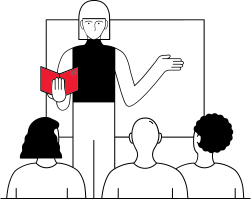
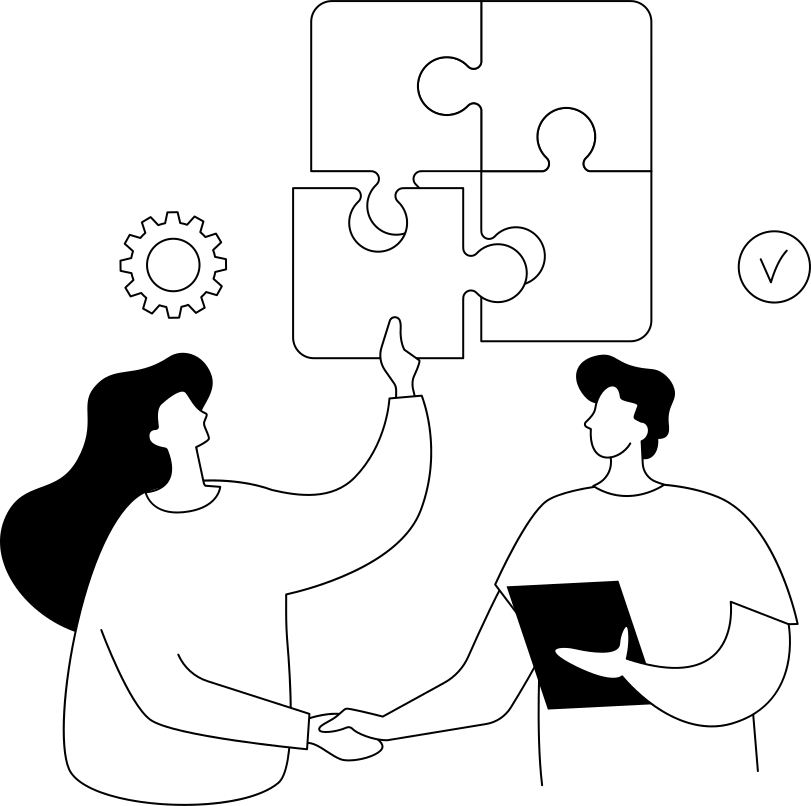
Lars: Sure. So when you engage in work, there are three different types of work that you actually engage in, whether you are aware about it or not. So the first type is predefined work. So that means working from your lists. Let's say you maybe have set aside a folder of emails that you want to get through. So that's your predefined work, your planned work. The second type is the work as it appears. So that's the unplanned work, work that just shows up. So that would be your phone ringing, your colleague stopping by your desk to ask for your help, that type of work. That is the second type. And the third type is defining your work. And that means to actually manage all of your inputs, to maintain them and get them into your GTD system. So really handling all the stuff that is coming at you. And getting that into, to, to your list so you can work from those lists in, in your predefined work. So that's the quick overview of the 3 different types of work mode.
Morten: Yes, and as you might gather, our dear listeners, this is something you actually are engaging in whether you know it or not. These are the 3 different main different categories that you can use your time when, whether, when you're at your office or when you're at home. You can do unplanned work. You just decided, oh, now my colleague comes in and I let this— this is most convenient to do right now. And defining work is when you set aside time for actually deep thinking, creating what am I going to do. You do your desired outcomes, your next action, thinking, clarifying, and organizing, and then you do predefined work is where you are moving on projects that you already decided to. So just to give you, the listener, a little depth on this. So if I am defining work, what am I doing when I'm defining work? When we, when it comes to GTD, what is in, what is in defining work, Lars?
Lars: So defining your work would be, for, for me, uh, is, is perhaps an activity that I would start my, my day with. It varies what I'm doing. Of course, if I'm out delivering a seminar, I would be out there. But if I'm working from my office, I would sit down with a good cup of coffee and then choose to either start doing some of my predefined work, meaning working from my list, or I would be defining my work. So I would be managing all the stuff that has shown up in my various inboxes. So really, in practical terms, because I get this question a lot that, you know, so what does a daily— what is a day for a GTD, or what does that actually look like? And that would either be mostly planned work. There is, of course, unplanned work if the phone rings, but otherwise it's also defining your work processing, all that stuff that has come in. So that could be my physical inbox, managing that, getting that to zero by clarifying and organizing, as we have discussed in previous episodes of this podcast. Or it could be my digital inboxes, or it could be perhaps, perhaps reflecting on some things as well, gaining an overview to make sure that when I engage in my, in my planned work, my predefined work, that I'm actually working on the, on the right stuff.
Morten: Exactly. So what happens if you have a lot of unplanned work? You don't have time to define your work. What will— what does that look like?
Lars: Well, the experience is that when you don't have enough time to do your— to spend time defining your work, meaning getting that overview and updating your systems, that means that you will naturally have less predefined work because you simply wouldn't have maintained that system to work from. So the only type of work left is simply is simply the unplanned work, the work as it appears. So really, a lot of our experience from the seminars in Denmark, and I'm sure it's the same case in Norway, is that when you start to identify how much of your day do you spend in each of these, then almost all participants will say, well, I wish I had more time to define my work. And most people will then leave the seminar understanding that they need to start working differently and really spending more time on this defining work step.
Morten: Yes, exactly. And as you said, we experience exactly the same thing in Norway. And I'm sure in the rest of the world, people will realize through our seminar that they need to define more work to get more of the right stuff done. Because if you're only working out of unplanned work, well, if you're a receptionist, this is of course the right way to spend your time. Unplanned work is your job. Your job will show up when somebody comes in the door and asks you for something or want to talk to someone, this— your job is to be interrupted then. But if your job is to create value, lasting value, where you have to think and reflect and make decisions, if you don't have time for defining your work as this, then you will be driven by the latest and loudest, and you will not be able to create longer-lasting value than you would if you defined your work. So predefined work is when you're actually working off a plan. You make a plan. I remember some time in the past, David Allen said something like this, that you have to plan your work and then work the plan. And this is what this is. You define your work, that's your plan, your work, and then you work the plan. You use the plan and then you work off your system. And if you look at the 5 steps of the methodology where we have clarify, where you capture everything that has your attention, and then you clarify what has your attention, you decide if you're going to do something about it or not, and then find your desired outcome and your next actions and then park it in organize, which is the third step where you put it in your system, and then you reflect Reflect, which is the fourth stage, where you look at everything you're committed to do to make sure everything is up to date and a good map of the future of what you're supposed to do. And then you have engage, do what you decided to do. So when we are defining work, we are using the three middle steps: clarify, organize, and reflect. These are the three main goals, sorry, 3 main objectives when we define your work in GTD. And then predefined work would be working off your calendar, that is engaged with what you've already decided to do. And then you will also have, you will see that the more you have defined of your work, the more overview you have, the better you will be feeling about when interruptions come, the more unplanned work that shows up when you are in the driver's seat, you're in your cockpit, you have full overview, full control, then you can decide very quickly if something comes in, if that's more important than everything else you've committed to do. And that could be anything from taking a phone call to deciding today I'm going to be in the hammock. Which is the beauty of GTD. You know, you get the full overview, you can make that decision in a split second.
Lars: And that also helps to, to, to relieve stress. It's my experience that once you get that overview exactly like you describe it, you know, a lot of stress, as David also said, come from, from these unfinished commitments. So helping you get this overview when you start really defining your work, that, that certainly helps the, the stress levels as well.
Morten: Yeah, exactly. So, and the idea behind this is not to force you into thinking differently in this threefold nature of work. It's just to make you aware that you actually have a choice. You have a choice if you're going to plan your work or your choice if you go and read your email, panic read your emails looking for something that you might want to do something about instead of then clarifying, organizing, and reflect on a regular basis so you define your work instead. And you have the choice to choose which of these three categories of work you want to be in in the moment.
Lars: And I think it's also worth adding that, at least I like that multitasking is really a challenge. And I've seen this a lot of places, learned it when we started working together as well, Morten, that really trying to understand, to focus on one thing at a time. So really picking what are you doing right now? Are you doing predefined work? Work? Are you defining your work? Or have you decided to pick up the phone and answer that call that came in now? Because at least my experience as a consultant before working with GTD was that I would tend to be doing my predefined work and I would sneak in defining work. So I would sit in a meeting and I would, you know, trust that I could multitask and listen to it and hear what was said. And at the same time, I could, I could empty my inbox as well. Problem. And as we know from a lot of different studies, that really isn't a sensible way to work. So really try to do one thing at a time.
Morten: It's a common misconception and a myth that multitasking is actually efficient and is good. Science is very clear on this now that there's no real multitasking where you try to reflect on two things at the same time. It does not work. It's not possible. And what is happening is that you switch between the two different reflections, and to reflect on two things at the same time comes with some costs. It burns your glucose levels in the brain faster, so you get easier decision fatigue. You're easier to then make decisions based on your gut feeling more than your common sense. And you also are getting tired faster, really tired, mentally tired faster. And you lower your IQ, things take a lot longer time. When I do my keynotes, I know you, you're doing the same thing, Lars, you do keynotes, and in the keynotes I do a test where I test if multitasking actually works on the participants in the keynote. And I see that at least 50% longer time to multitask than to single task. Have you seen the same thing, Lars?
Lars: Yes, exactly. That's certainly the case in Denmark. It varies rather interestingly. It really varies between people, but nobody works well when they're— that's for sure.
Morten: Yeah. So that is the threefold nature of work. Anything to add to this now? Have we emptied the— Knowledge markets.
Lars: I think it's just worth, you know, people need to also understand that there is certain, of course, that is logically makes sense, but really try to set aside time and understand that you need time to do this. And it certainly makes sense in the end. I've seen different numbers depending on how much input you have, but I think maybe 30 to 90 minutes would be a starting point for defining your work. So it's not time that you you need to go out there and find in your schedule maybe because you're already— most people would already be doing this because they're doing their job. But really set that aside as a separate thing that you do during the day that you process your inbox and define your work. And that would be one last thing for me to add.
Morten: Yeah. And that is like this, most knowledge workers today make up their work as they go along. There's often not clear no clear boundaries of what you have as your areas of focus. What is your job really? And you have to make it up. You have to make up your job. If you don't make up your job, you don't— you're just being reactive. And, you know, to plan your work is essential, or you will be driven by latest and loudest, as David would say. So, okay, let's move on to the limiting criteria. Lars, What is this really? What is the limiting criteria?
Lars: Sure. So when you engage in your planned work, there are varying criteria that limit you in what you can do. So these are steps that would help you decide what would be the right thing for me to engage in at this moment. So the first limiting criteria is context, meaning where am I right now? Who am I with? Which people are available to me? So that's why we structure the next actions list. Those are based on the Context, meaning, you know, that you have a list at your computer at the office, people you need to talk to, you need to call, stuff to do at the summer house, etc. So that would be the first limiting criteria, the context. After that, you have time available. So how much time do you actually have before you need to do something else, whether it's to head home for the day or your next meeting? How much time is available? Because that will help you decide as well, you know, which, which next action should I actually pick to work with right now? If you only have you have 10 minutes until the next meeting and you have a 2-hour next action on your list, then maybe one of the smaller actions would be more suitable for the time that you have available. And last but not least is the resources. How much energy do you actually have? So when you have the option to choose from various next actions, then some actions will require more energy. So if I'm writing an article for a newspaper or something, I need to need more fresh energy. I shouldn't be doing that noon, I should engage in some low-level tasks that don't require much of my creative brainpower. So that's the last of the limiting criteria. That's the resources, the energy that you have available.
Morten: Yeah, great. And just to clarify further is that when you, when we talk about the limiting criteria, this is first and foremost what's on your lists. So if you are in a your workplace, you look at your calendar would be the first place to look. What have I decided to do today? And it could be meetings, and it could also be set aside time slots for you to do a specific task, do some routine work, or to do next actions, or to move a project forward. But if there's nothing on your calendar, then you use the limiting criteria to help you choose what to do in the moment. So if I have 2 hours, I'm in the office, I feel a little tired. It's close to 4 o'clock and my brain is semi-shutting down. What can I do? And before, if you don't have this way of looking at it, you will be— if you don't have the GTD system, you will maybe be driven into reading emails and responding to emails because then at least you feel a little productive. You feel that you're moving something forward. That might not be the best thing to do. If you in advance create lists of what you can do by defining desired outcomes and clear physical next actions where you have everything you need, then you can make progress on even the most important and maybe difficult things even when your brainpower is low, your mental resources. Is low. Anything to add to this, Lars?
Lars: No, I think you said it very well. I think especially the overview is one of the things that can stop people from being productive. So they tend to fall back on other stuff. And then certainly the way to structure work by next actions is also really an interesting part of GTD. I recently did a workshop for a company where we discussed this. And for some people, it takes a bit of time time to get used to structuring your work in this way. So a lot of people that I work with are used to, you know, they have a— their mind is big projects that they are working on. So when they would decide what to do, they would normally just go for one big project or the other. But having this list of next actions to work from is just so much more productive. You can really utilize all the various holes in your calendar for, for the right stuff to, to work on. So it, it really is a big difference in the way to work and to get things done.
Morten: Yeah, exactly. Well, um, time, I think, now for go for landing. We are closing in on our 20-minute time goal for this. Um, will you take us down the goodbye trail, Lars?
Lars: Sure. So, so where can you find more information about GTD? Well, you go to GTD www.gtdacademic.com. You can find all of our various groups and pages across social media, Facebook, etc., GTD Meetups. Find us on LinkedIn, Instagram, etc. And as mentioned in the beginning, we really hope that you find these episodes valuable, and if you do, we'd really appreciate it if you share the podcast with a colleague or rate us on iTunes.
Morten: Yeah, great. And until next time, I hope we've given you some value. I hope that we have given you something that will help you in your journey to learn GTD. And, um, you know now where to find us. And until next time, have a great two weeks.
Lars: Bye-bye! Bye everyone!